Driver-Based Budgeting
& Scenario Analysis
How a healthcare group replaced rigid static budgets with a flexible, continuously-updated, driver-based model — and saved 650+ hours annually.

The Challenge
Budgets were outdated by the time they were approved. Static line-item models couldn't keep up with the real pace of decision-making.
A healthcare group with multiple locations relied on a traditional static budgeting process built in Infor and spreadsheets. Each budget cycle required 600+ hours of manual input, cross-referencing, and consolidation across departments.
The resulting budget was inflexible. When assumptions changed — new hires, reimbursement changes, volume shifts — the entire model had to be rebuilt. Scenario analysis was theoretically possible but practically never executed due to time constraints.
The organization needed a budgeting approach that moved at the same speed as the business — one that could answer "what-if" questions in minutes, not weeks.
How We Automated It with AI
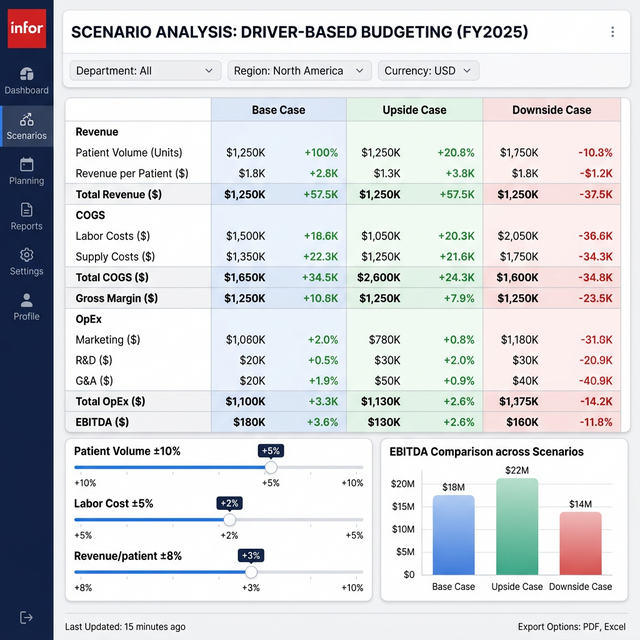
We replaced their static budgeting process with a driver-based model that connects to Infor and updates automatically. The core innovation: instead of budgeting by account, we modeled the business drivers — patient volume, staffing ratios, and revenue per patient — and let the system build the financials from there.
Leadership can now run unlimited "what-if" scenarios using sensitivity sliders: What if patient volume drops 10%? What if labor costs increase 5%? Results appear instantly across all three scenarios (Base, Upside, Downside).
Driver-Based Models
Build budgets from business drivers: volume, pricing, staffing ratios — not individual GL lines
Unlimited Scenarios
Run Base, Upside, and Downside scenarios with any combination of driver assumptions
Sensitivity Sliders
Drag sliders to see instant impact of ±10% material cost, ±5% volume, and more
Continuous Forecasting
Replace discrete annual budgets with continuously-updated, rolling forecasts
Results
(was 4–6 weeks)
annually
scenarios
from efficiency
10-Week Rollout
Weeks 1–3
Driver identification, Infor data extraction, and model architecture
Weeks 4–5
Driver-based engine, scenario framework, and sensitivity controls
Weeks 6–8
Dashboards, EBITDA visualization, and multi-entity consolidation
Weeks 9–10
Department training, parallel testing vs. static model, and go-live
"Budget season used to dominate our Q4. Now we have a living model that updates weekly. When the board asks 'what if?' we have the answer in 10 minutes — not 10 days."

We automate manual budgeting
with AI and custom tools
Book a free 30-minute call. Walk away with a workflow map, quick-win list, and a start-here plan — whether you work with us or not.
Book a free call →