Driver-Based Budgeting
& Scenario Analysis
How a healthcare group replaced rigid static budgets with a flexible, continuously-updated, driver-based model - and saved 650+ hours annually.

Static Budgets Can't Keep Up
Traditional budgeting is built for a world that doesn't exist anymore. It assumes stability, predictability, and the luxury of time. Healthcare has none of those.
Most organizations still budget the same way they did 20 years ago: start in Q3, fight over line items for 8-12 weeks, publish a static document in January, and watch it become irrelevant by March. When assumptions change - and in healthcare, they always do - the budget can't flex with them.
Enterprise CPM tools like Adaptive Planning and Anaplan address this for large corporations. But multi-location healthcare groups running Infor or Sage are often stuck with static spreadsheets - and the painful budget season that comes with them.
Meet the Client
A healthcare group with 5 locations, 800+ employees, and $50M in annual revenue. They ran Infor as their ERP and budgeted the old way - line by line, department by department, once a year.
Each annual budget cycle consumed 600+ hours across the finance team and department heads. The VP of Finance coordinated assumptions, chased down inputs from 12 department managers, consolidated everything in Excel, and presented a final budget that was already outdated by the time it was approved.
Scenario analysis? Theoretically possible. Practically? Never. Running one "what-if" scenario - say, a 10% drop in patient volume - required rebuilding the entire model. Nobody had the time.
The real cost wasn't just time - it was agility. When the board asked "what happens if reimbursement rates drop 5%?", the answer took a week. When a competitor opened a new facility nearby, the team couldn't model the revenue impact for two months. The budget was supposed to be a planning tool. Instead, it was a planning constraint.
The Annual Budget Process
The budget was a static document. When the world changed - and in healthcare, it changes constantly - the budget couldn't change with it. Patient volume shifts, staffing changes, new regulations - every surprise required manual rework that the team simply couldn't absorb.
How We Built the AI Solution
We replaced their static budgeting process with a driver-based model that connects to Infor and updates automatically. The core innovation: instead of budgeting by account, we modeled the business drivers.
Patient volume, staffing ratios, revenue per patient, supply costs per procedure - these are the levers that actually drive healthcare financials. We modeled the relationships between drivers and financial outcomes, so changing one driver automatically recalculates everything downstream.
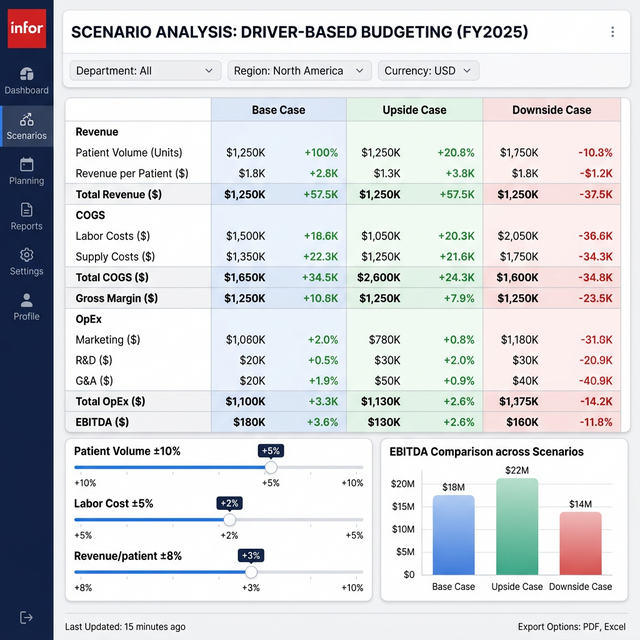
Leadership can now run unlimited scenarios using sensitivity sliders: What if patient volume drops 10%? What if labor costs increase 5%? What if we open a 6th location? Results appear instantly across Base, Upside, and Downside scenarios.
Driver-Based Models
Build budgets from business drivers - volume, pricing, staffing ratios - not individual GL lines
Unlimited Scenarios
Run Base, Upside, and Downside scenarios with any combination of driver assumptions
Sensitivity Sliders
Drag sliders to see instant EBITDA impact of +/-10% volume, +/-5% labor cost, and more
Continuous Forecasting
Replace discrete annual budgets with continuously-updated, rolling forecasts tied to Infor actuals
Before vs. After
Results That Redefine Budgeting
(was 4-6 weeks)
annually
scenarios
from efficiency
But the real impact was strategic. When the board asked about the financial impact of opening a 6th location, the VP of Finance had the answer in the same meeting - not two months later. Budget season went from a Q4 nightmare to a 3-day process. And the model now updates weekly with Infor actuals, giving leadership a living, breathing view of financial performance.
Still Running Budget Season Like It's 2005?
If your budget cycle takes more than a week, your process is holding your strategy hostage. We'll show you how driver-based models can compress months into days.
Get a free workflow analysis →10-Week Rollout
Weeks 1-3: Discover
Driver identification across all 5 locations, Infor data extraction, and model architecture design. Map the relationships between operational drivers and financial outcomes.
Weeks 4-5: Build
Driver-based engine, scenario framework, and sensitivity controls. Base, Upside, and Downside scenarios with real-time recalculation.
Weeks 6-8: Visualize
Executive dashboards, EBITDA visualization, P&L waterfall charts, and multi-entity consolidation across all locations.
Weeks 9-10: Launch
Department training for all 12 managers, parallel testing vs. static model, board presentation rehearsal, and production go-live.
"Budget season used to dominate our Q4. Now we have a living model that updates weekly. When the board asks 'what if?' we have the answer in 10 minutes - not 10 days. It's completely changed how we think about financial planning."

Frequently Asked Questions
Stop Spending 6 Weeks
on Budget Season
Book a free 30-minute call. Walk away with a workflow map, quick-win list, and a start-here plan - whether you work with us or not.
Book a free call →